Employees start work from one entry point, without installing an environment, hunting for keys or picking a model. What each of them may use — models, agents, data — follows their project role. And every run lands on one ledger: who started it, and what it cost.
Employees start work in one place. Each execution remains attached to its project and owner.
Who uses it
Companies, public institutions and individuals run on the same platform
One set of workspaces, permissions and execution records underneath. A company wants AI doing actual jobs; a public institution wants the boundary settled first; an individual wants one place that holds the project and its history.
Companies
Put AI into specific jobs
Workflows break a job into steps and AI teams split it by role, so staff do not have to learn how to prompt first
A method that worked once becomes a template the next project reuses
Usage and cost land on a person, a project and a model, so you can see which team is getting value
Public institutions
Settle the boundary before the usage
Access control decides who may use which models, data and tools, and follows the person's role
Requests, approvals, login logs and execution records all leave a trail you can check later
Private or hybrid deployment covers a requirement that data must not leave your premises
Individuals
One place that holds the project, the files and the history
A workspace is a real machine with its own vCPU, memory and disk, not just a chat box
Files, context and output stay with the project, so another laptop picks up where you left off
Install the capability you need from the market instead of configuring an environment
Core value
Opening AI up takes three things at once
Miss one and AI stays where it is: a few people trying things on their own accounts. Hold all three and you can hand it to a department, then to the company.
One entry point
Nobody builds their own setup
Signing in drops an employee into the projects they may access. The runtime, the models, the agents and the keys are already configured. Work that used to live in personal accounts and personal laptops comes back into the project.
One set of permissions
You decide what AI may see and touch
Project roles set the models, tools, files and actions available. Agents that support permission prompts ask before running a tool or a command. Opening up access is not the same as opening up the boundary.
One ledger
Every run can be costed and traced
Who started it, which project, which workspace, which model, how many tokens and how much money — all on the same record. Enough to review the work, charge it back, or hand it to someone else.
You do not have to lock everyone into one AI tool. We manage the models, agents and workspaces that are already integrated and licensed. During a pilot we check interfaces, licensing and deployment conditions item by item.
What it looks like
The entry point, the permissions and the ledger, on screen
These are real product screens, and you can open each one full size. People, projects, agents, models and operating figures are replaced with demo data.
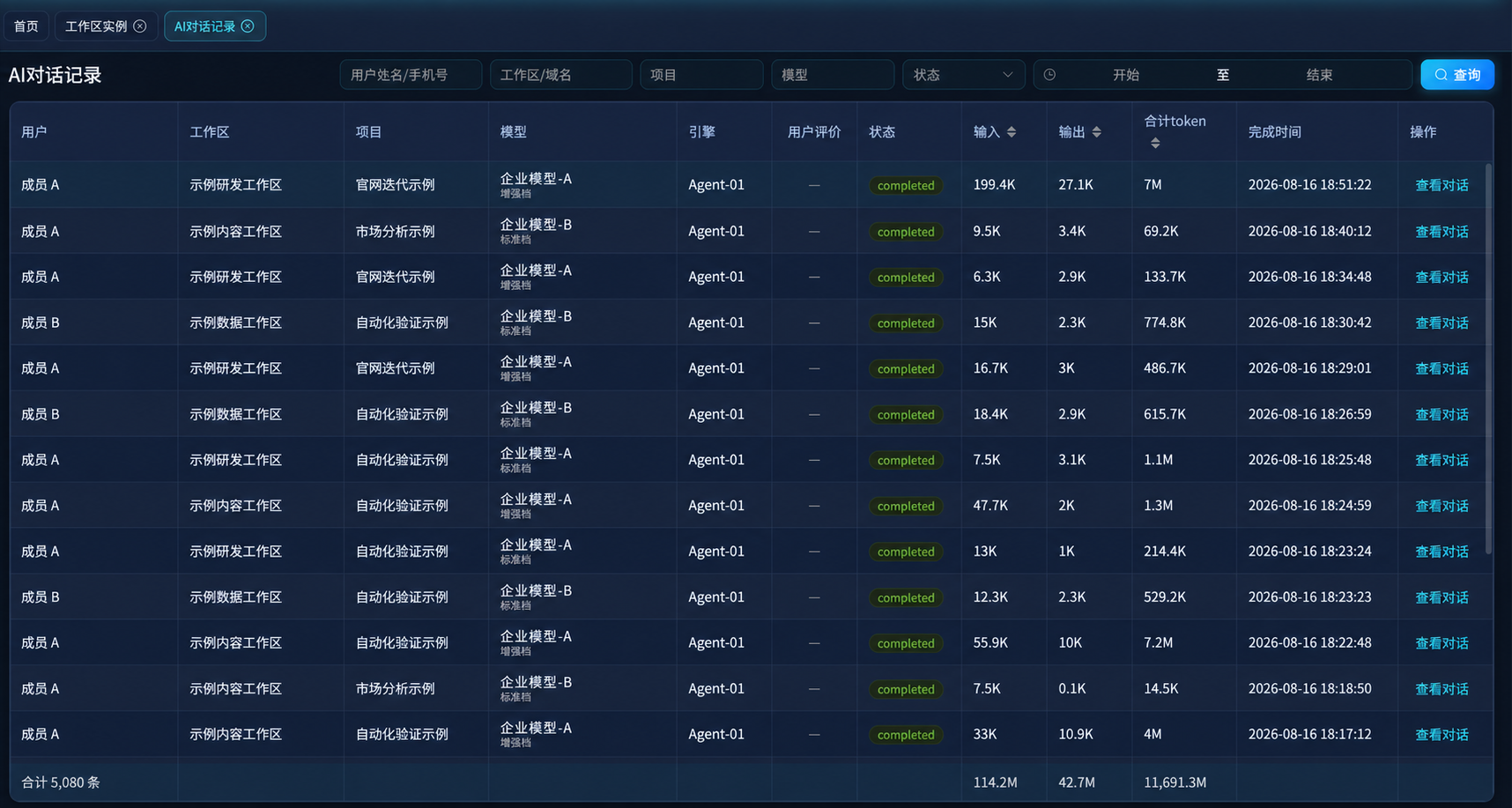
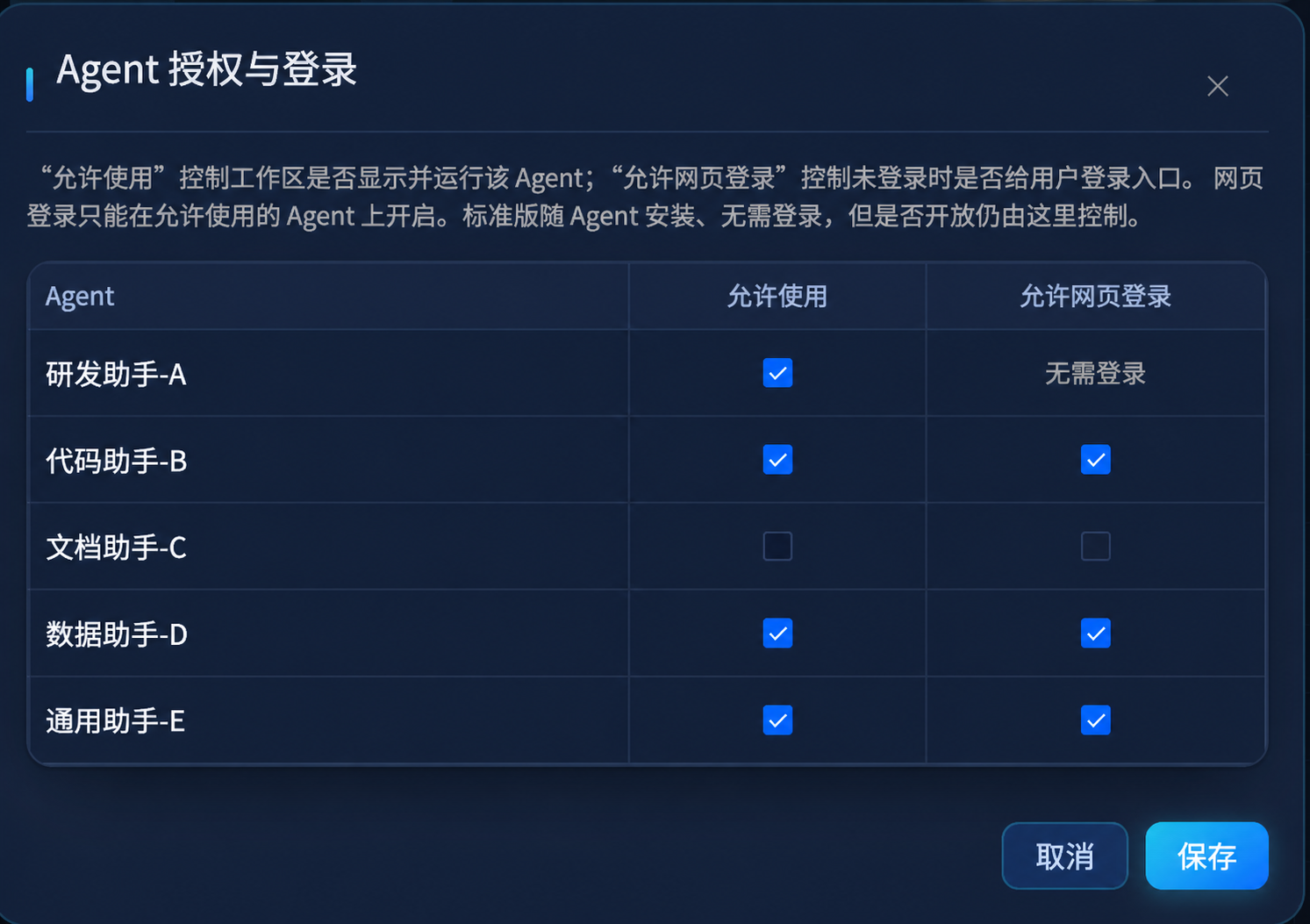
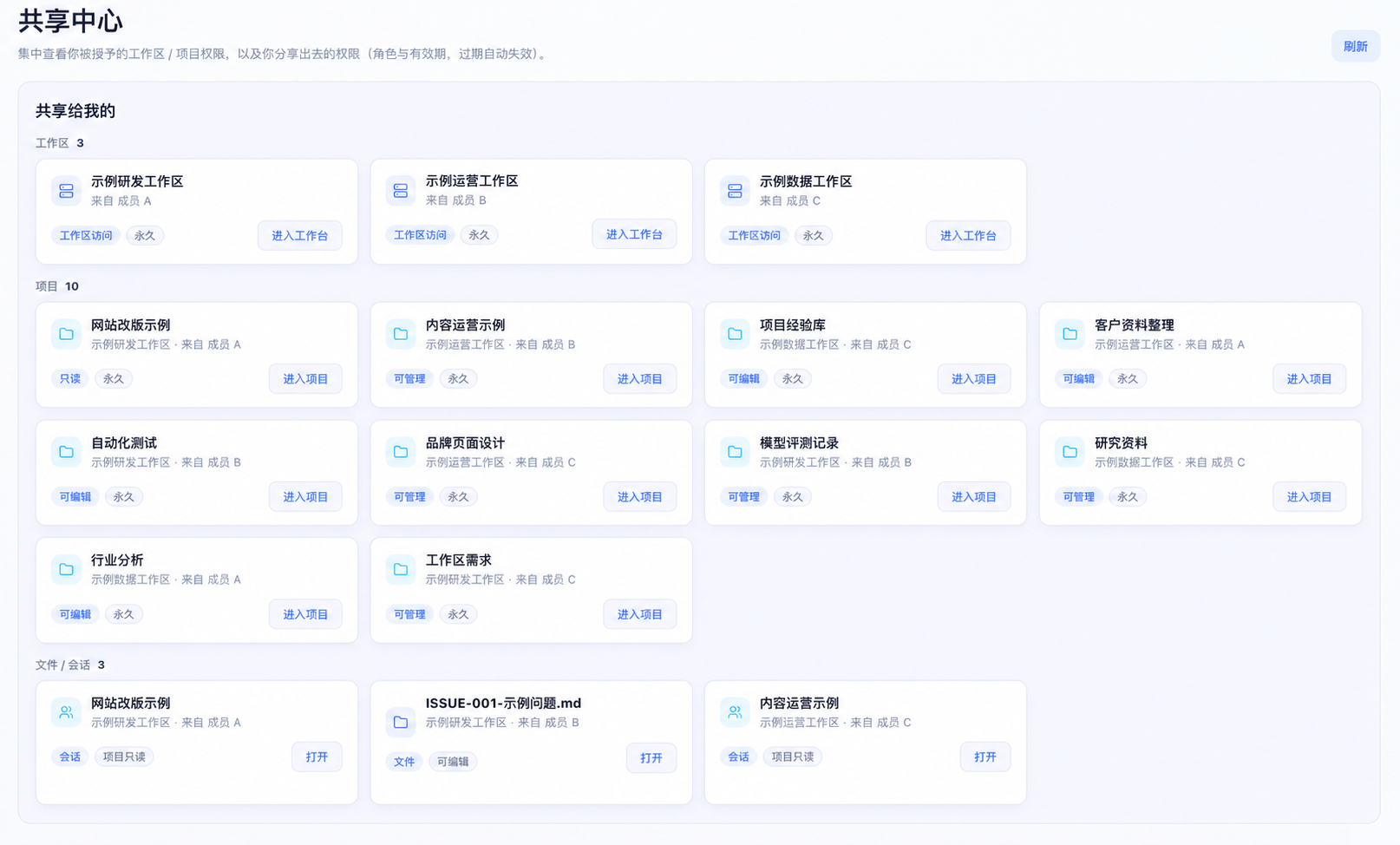
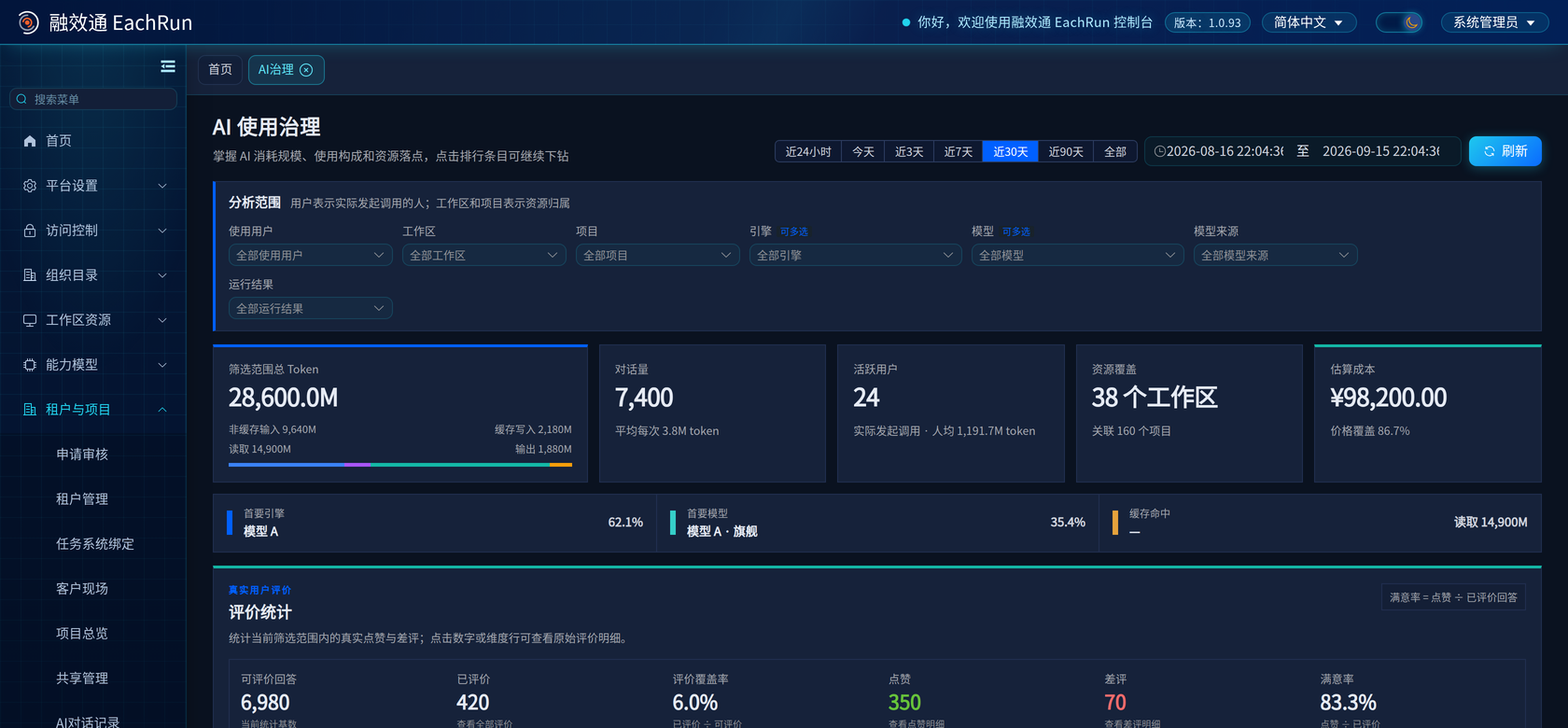
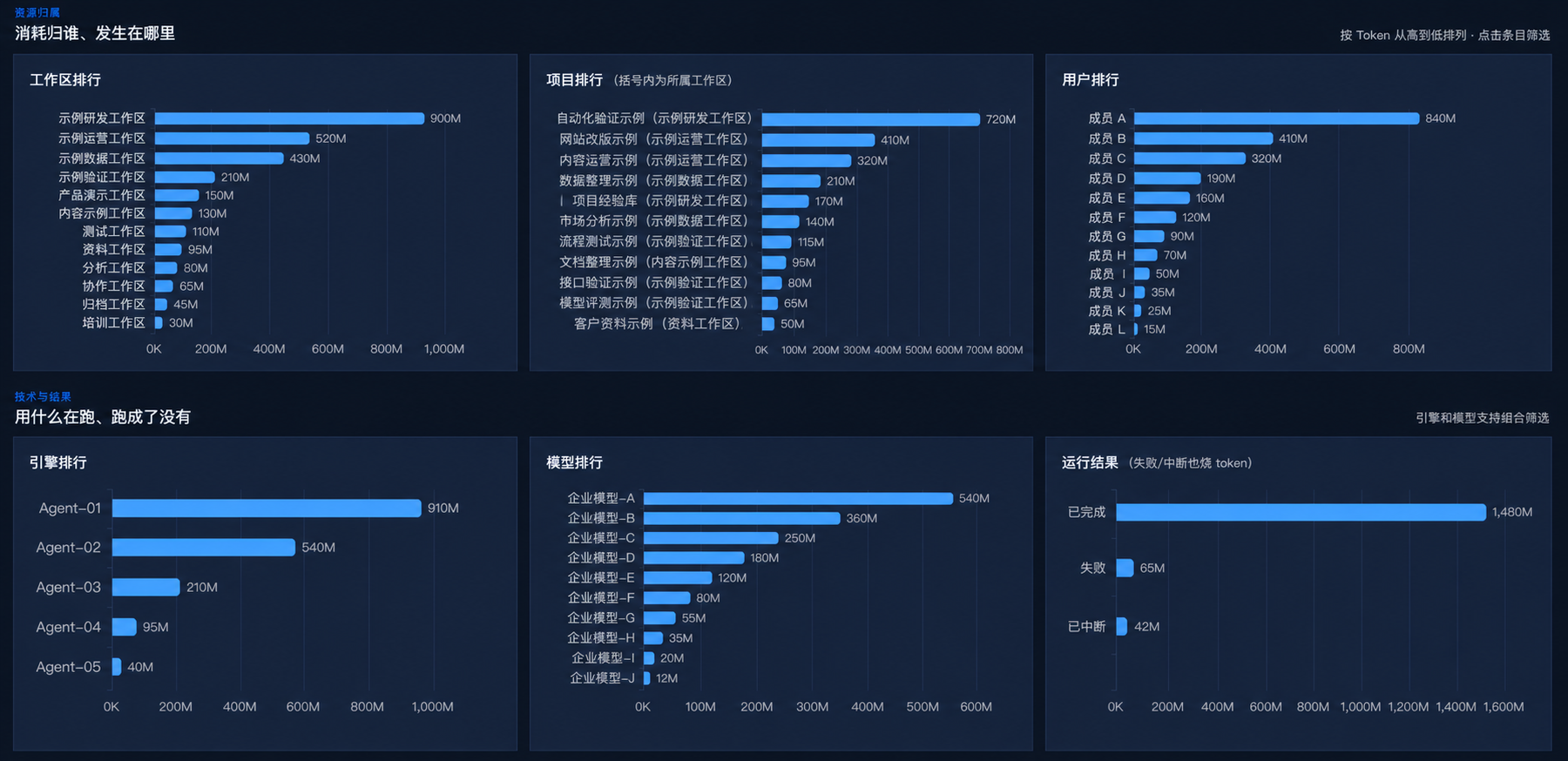
AI conversation recordsSearch by user, workspace, project, model and status while retaining usage and completion time.Agent accessAdministrators decide which agents may run in a workspace and whether web login is available.Share centerWorkspaces, projects, files and sessions carry roles and an access lifetime.AI governanceFilter by user, workspace, project, engine, model and run outcome, then read tokens, active users, cost and user ratings for that slice.Usage and run outcomesBreak usage down by workspace, project, user, runtime and model, then review completed, failed and interrupted runs.
How it lands
How AI work enters company control
Six steps, and a piece of AI work has an entry point, a boundary and a ledger entry. None of it is an extra approval layer; it is the path the employee was going to walk anyway.
01
Enter a project
An employee signs in through the platform and starts inside a project they may access.
02
Request a workspace
The employee requests an environment; an administrator reviews and assigns resources.
03
Choose a capability
The workspace exposes the models, agents, project files and tools configured by the company.
04
Confirm before action
Project roles limit access. Supported agents request approval before running tools or commands.
05
Record usage
User, workspace, project, runtime, model, status and token usage remain searchable.
06
Share and hand over
Projects, files and sessions can be shared by role and expiry, then revoked when needed.
One place to work, one place to manage it
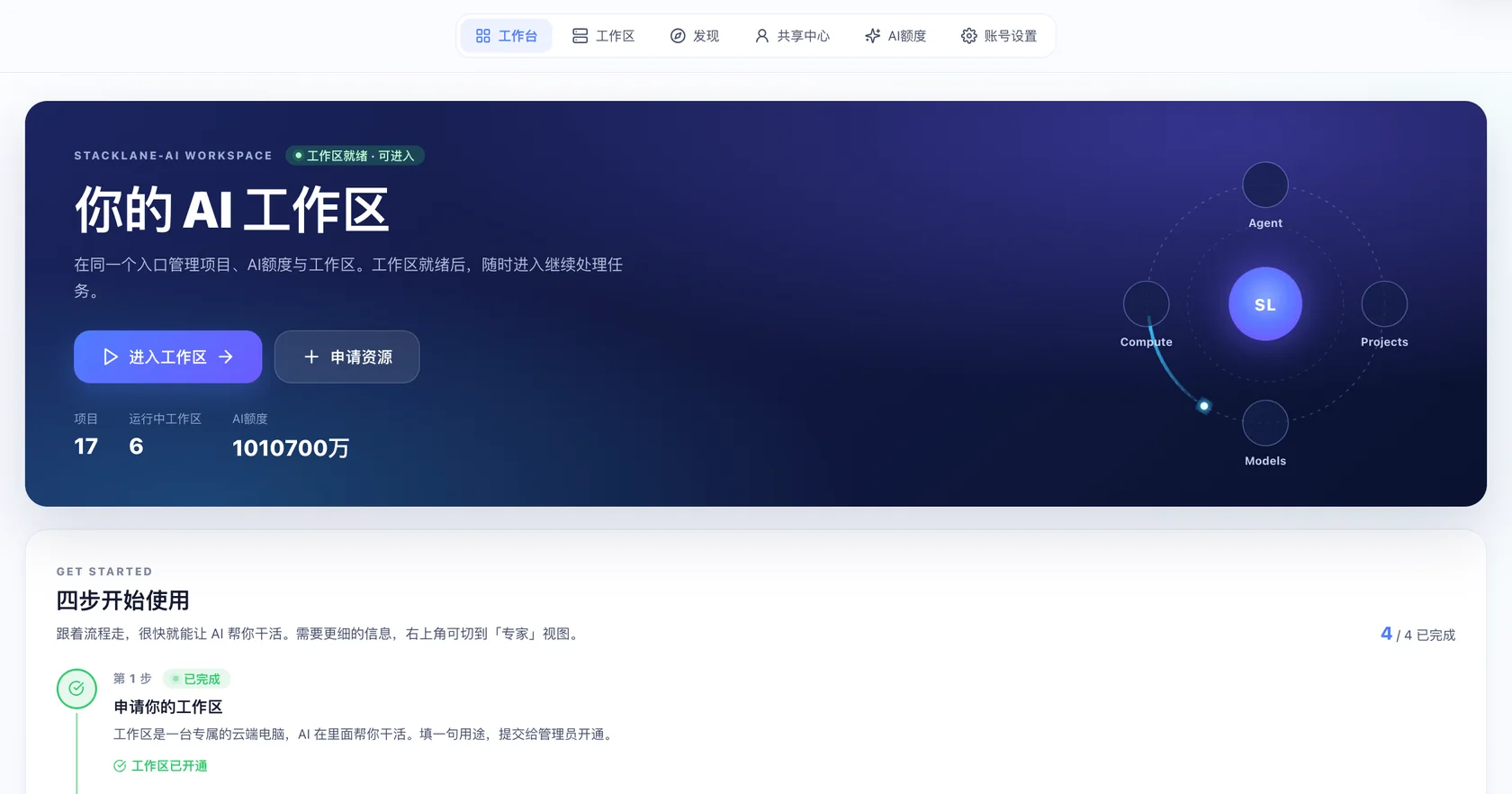
The entry point, the permissions and the ledger live across these seven screens. Employees use the first four daily; administrators watch the last three.
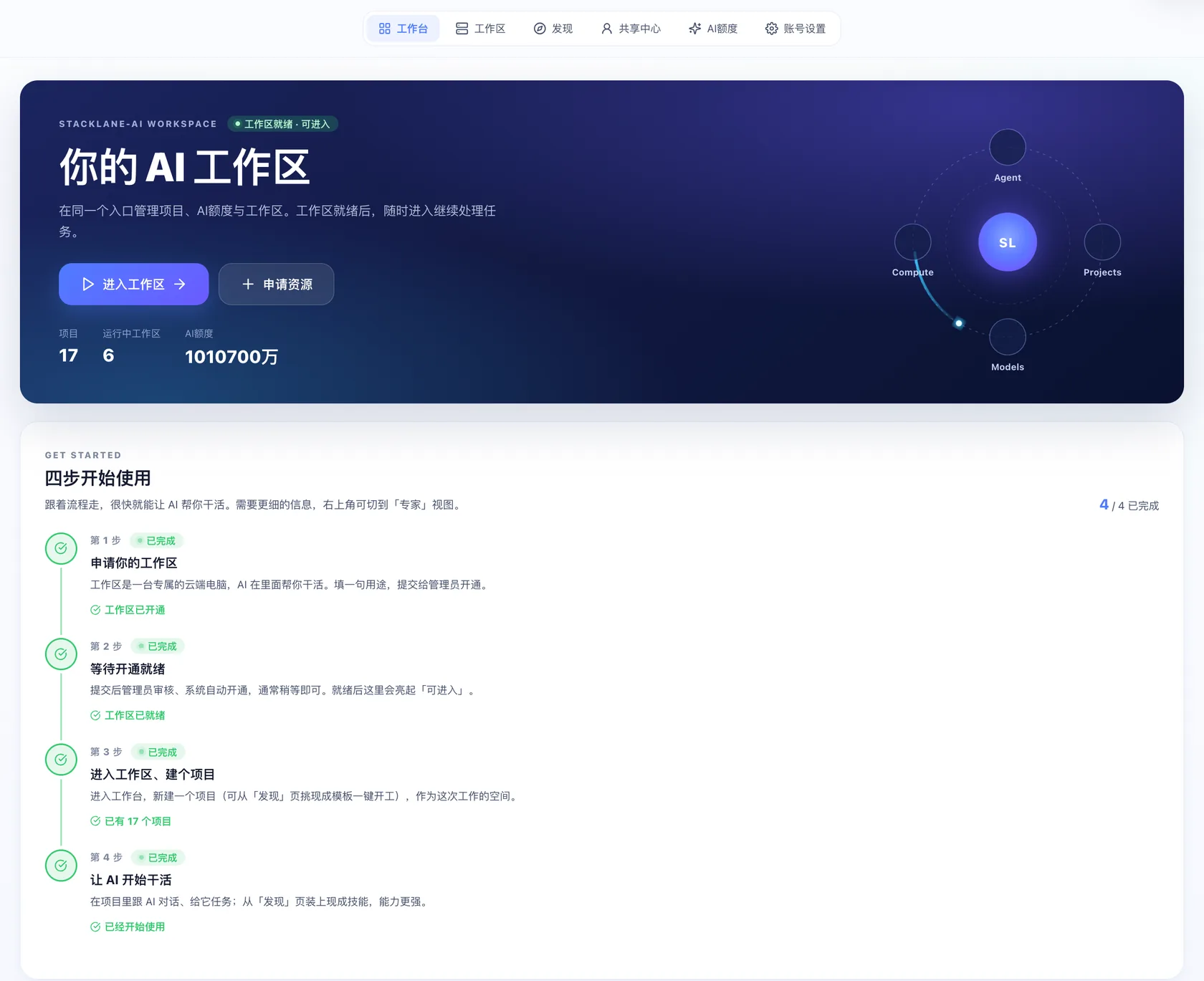
Employees do not install an environment or track down keys. The workbench guides them through a workspace
request, and they enter the project once an administrator approves it.
Request a workspace, an administrator approves it
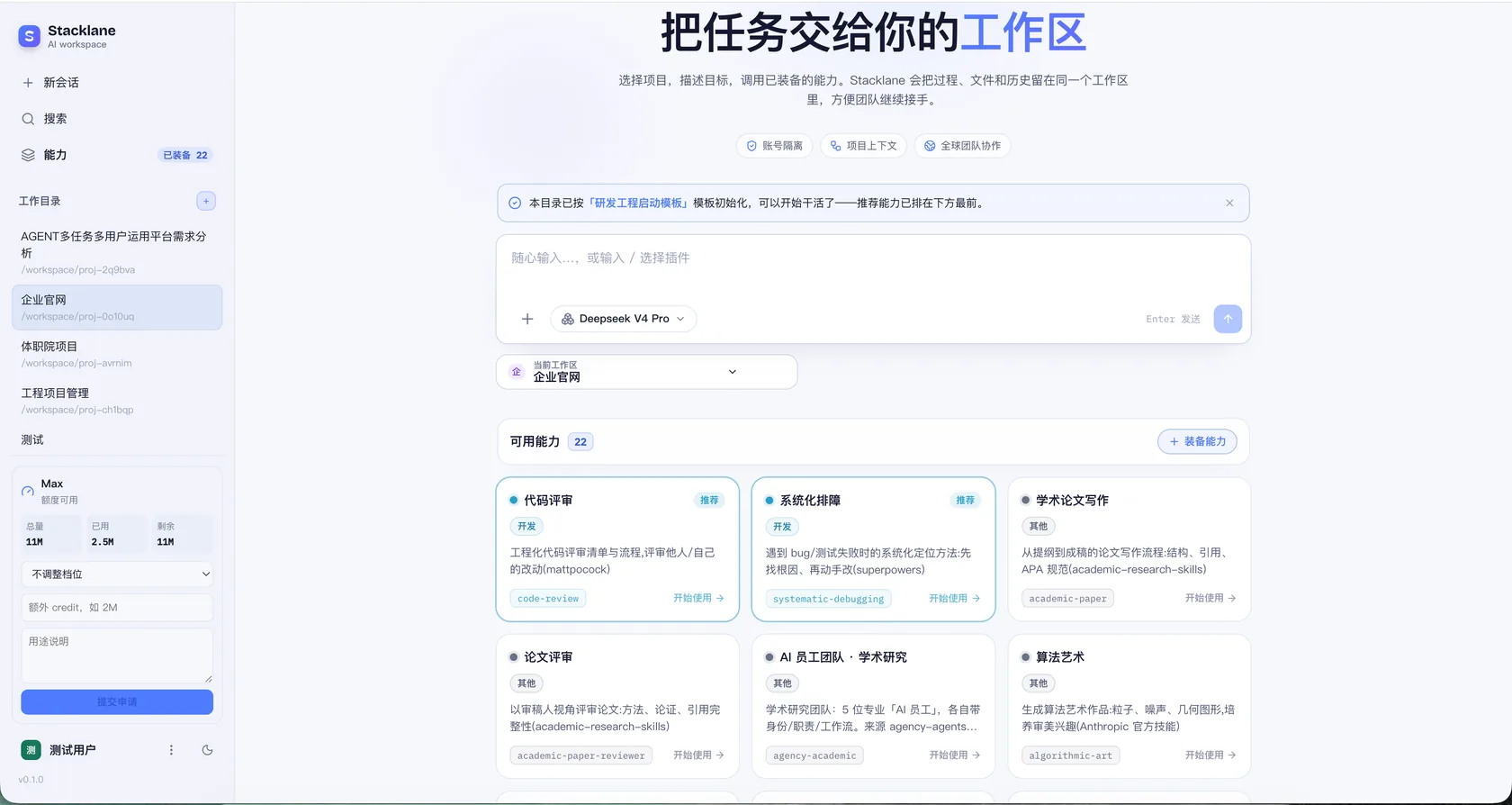
Projects, running workspaces and remaining quota on one screen
Switch to the expert view when finer control is needed
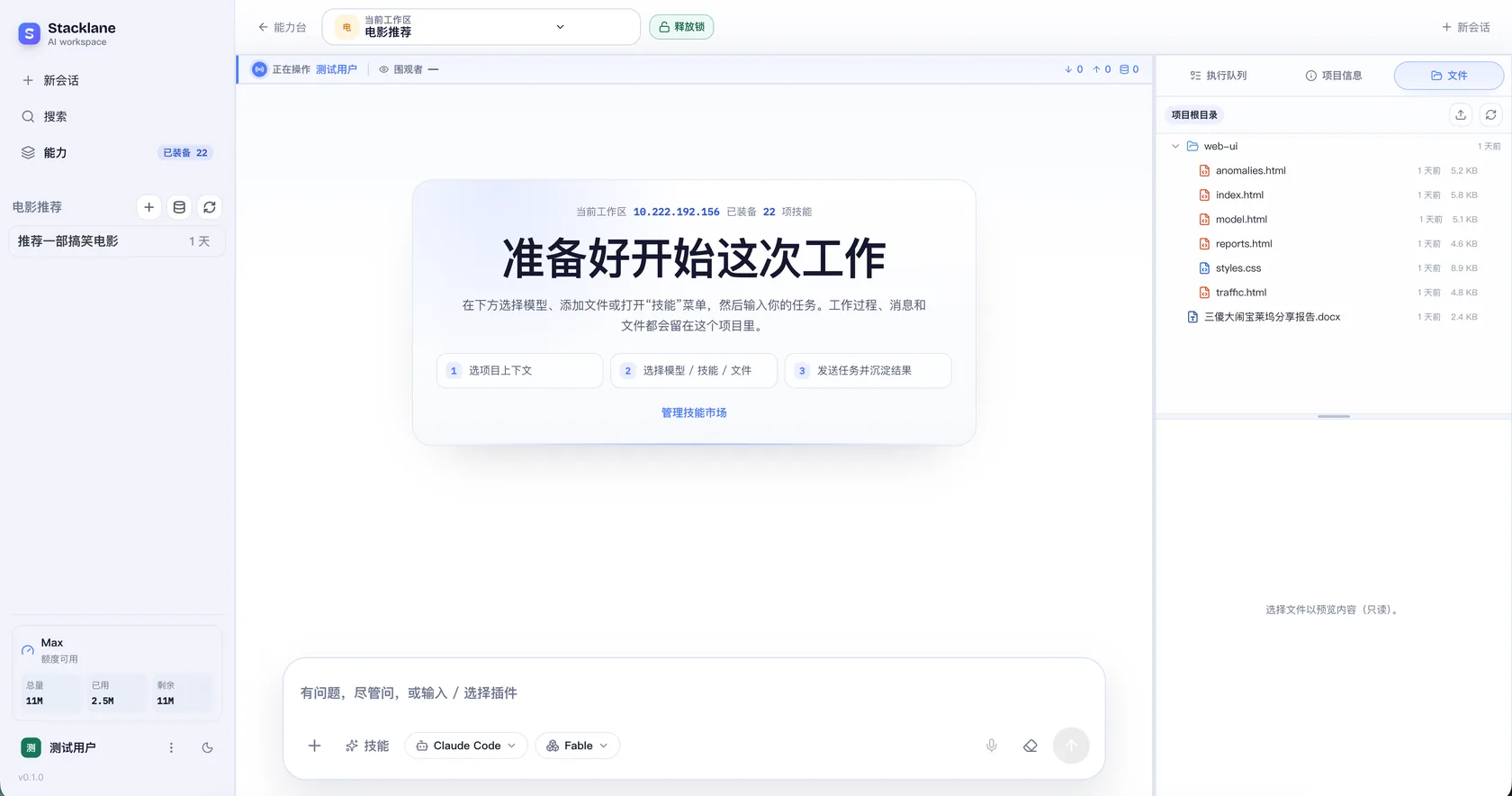
Three steps to start: pick a project, add the capabilities you need, describe the goal.
Workspace
Keep project files and context in one workspace
The workspace is the project's own environment. Files, context, tools and execution records live inside
it, and a colleague can be added to the same workspace and continue.
A standard environment that does not depend on one person's laptop
Project files, context and execution records kept together
Several people in one workspace for collaboration and handover
The workspace carries its own sessions, messages, apps and capabilities; project files and history stay inside it.
Runtime
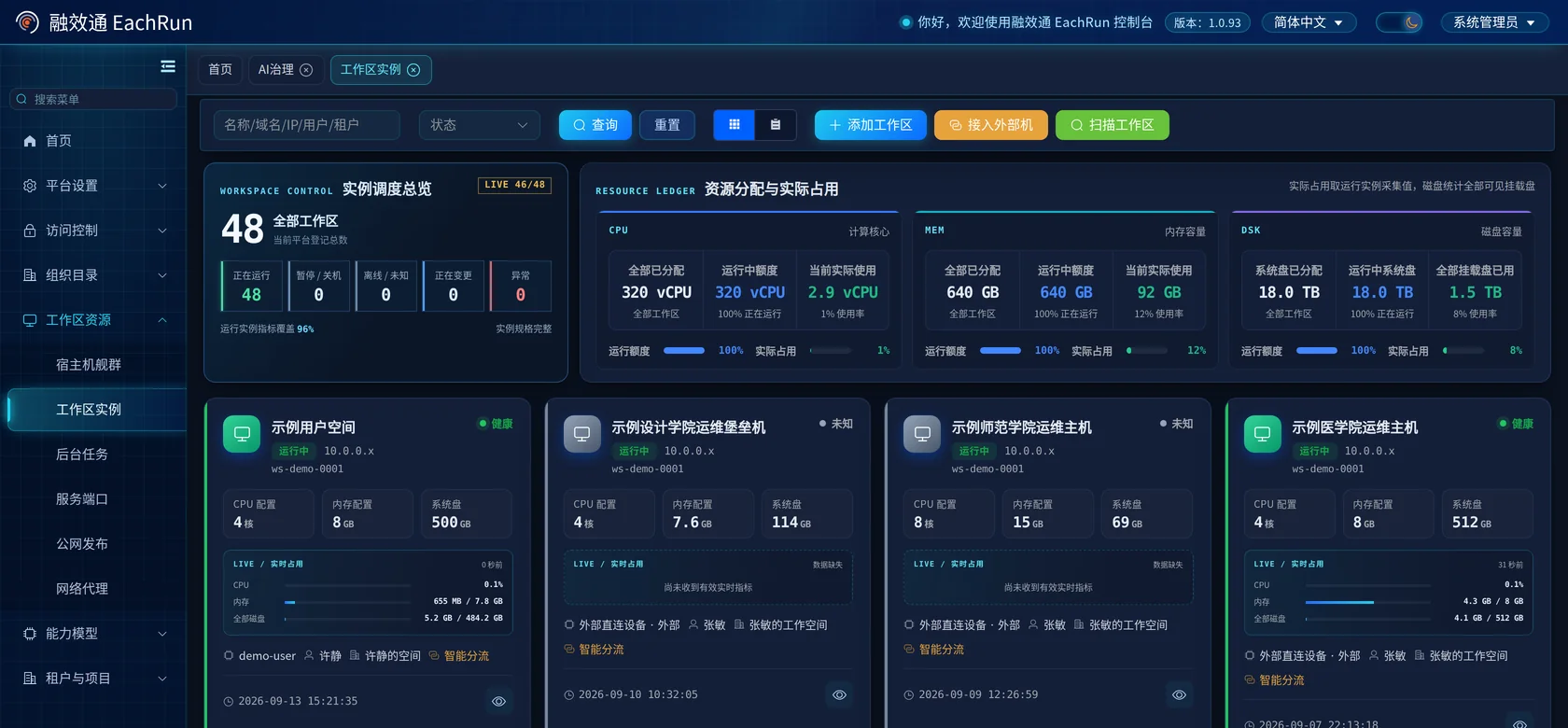
A workspace is a real machine, not just a chat box
Behind each workspace sit real vCPU, memory and disk quotas running on your own hosts. Administrators see
what was allocated and what is actually in use, and can expose a service running inside a workspace by port.
vCPU, memory and disk allocated per workspace, with live usage on one screen
HTTP services inside a workspace can be opened by port; public access needs review
Existing servers can be attached and managed in the same resource view
Allocated, running quota and actual use side by side, so resource spend is visible.
Discover
Approved models and agents stay inside the project
Employees see only the capabilities connected by the company and allowed for the current project. They can
switch models or agents without moving project files elsewhere.
The company connects models and agents once, not per employee
Availability follows role and project
Project context is kept when switching
Capabilities are installed into the workspace, so people can see what is on and what else is available.
Share center
Reuse work that the team has already done
The team can publish prompts, task templates and processes to the share center. They remain available when
people change roles or leave the project.
Prompts, task templates and processes become team assets
New projects start from something already proven
The method stays when people change
Approved templates turn proven ways of working into assets the next project can reuse.
AI quota
Give every unit of AI usage an owner
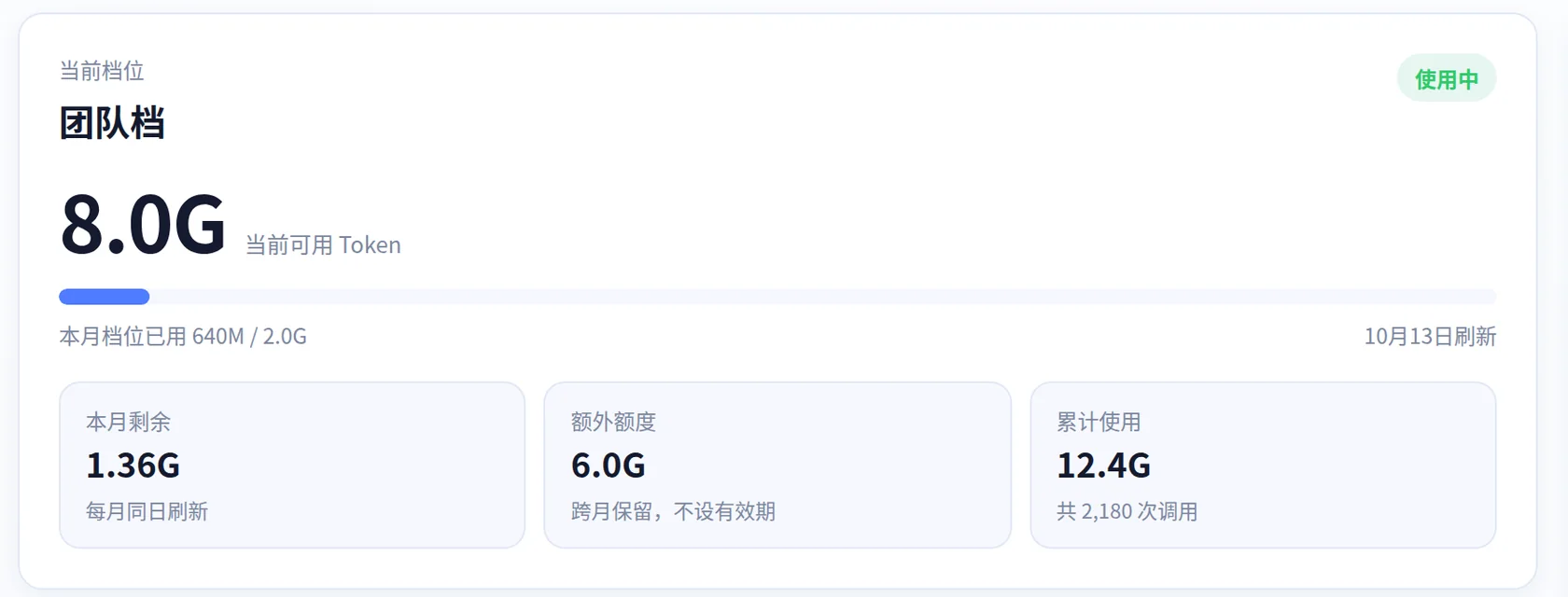
Quota is assigned by user and plan. Employees see what remains, while administrators can review usage by
workspace, project, runtime and model.
Set limits in advance instead of discovering spend later
Usage by person, workspace, project, runtime and model
Cost attributable to a project for internal allocation
Employees see what is left and how fast it is going, and can request more without leaving the product.
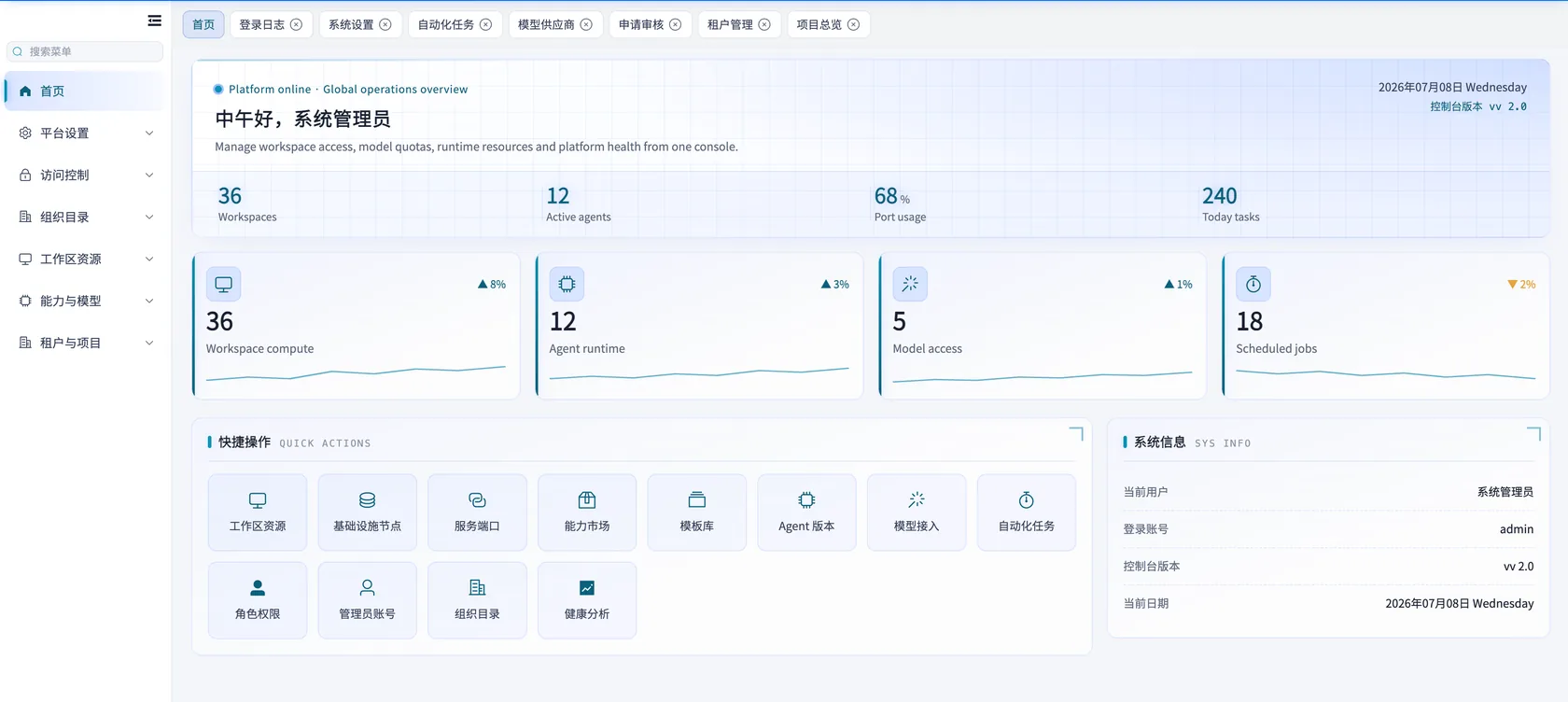
Admin console
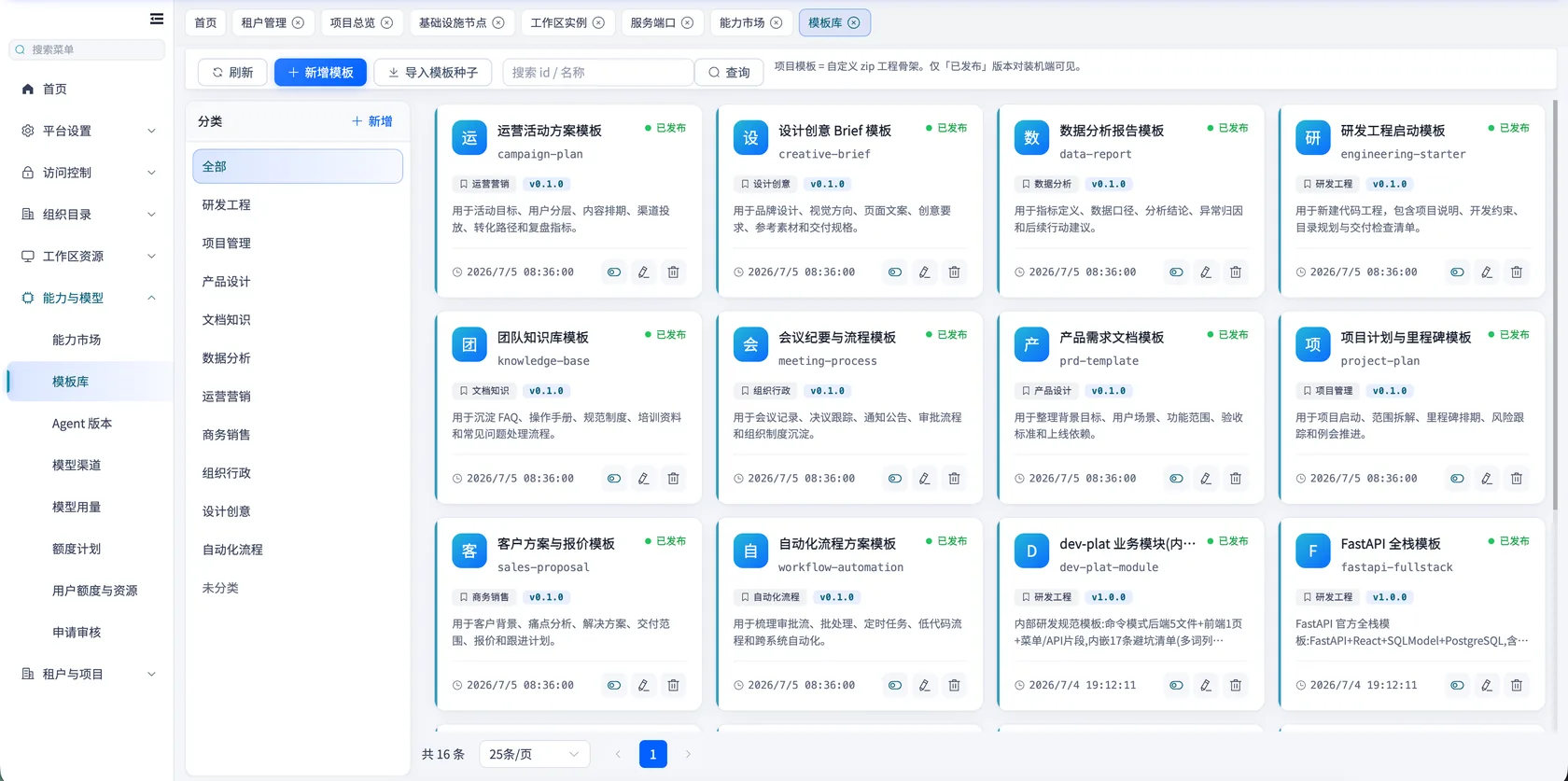
Daily administration in one console
Administrators handle workspace resources, member access, model providers, approval requests and login
records here.
Access control and roles decide who may use what
Model providers and keys held centrally, not scattered
Approvals, login logs and scheduled jobs in one place
Admin console: workspace resources, capabilities and models, tenants, projects and access.
On top of the core
Staff who cannot use AI can still follow the flow
The three things above decide whether you can open AI up at all. This layer decides whether people use it once you do: pick a workflow and follow it, or call in an AI team already split by role. Not required — but it sets how fast AI spreads inside the company.
Workflows
Pick a workflow and follow it
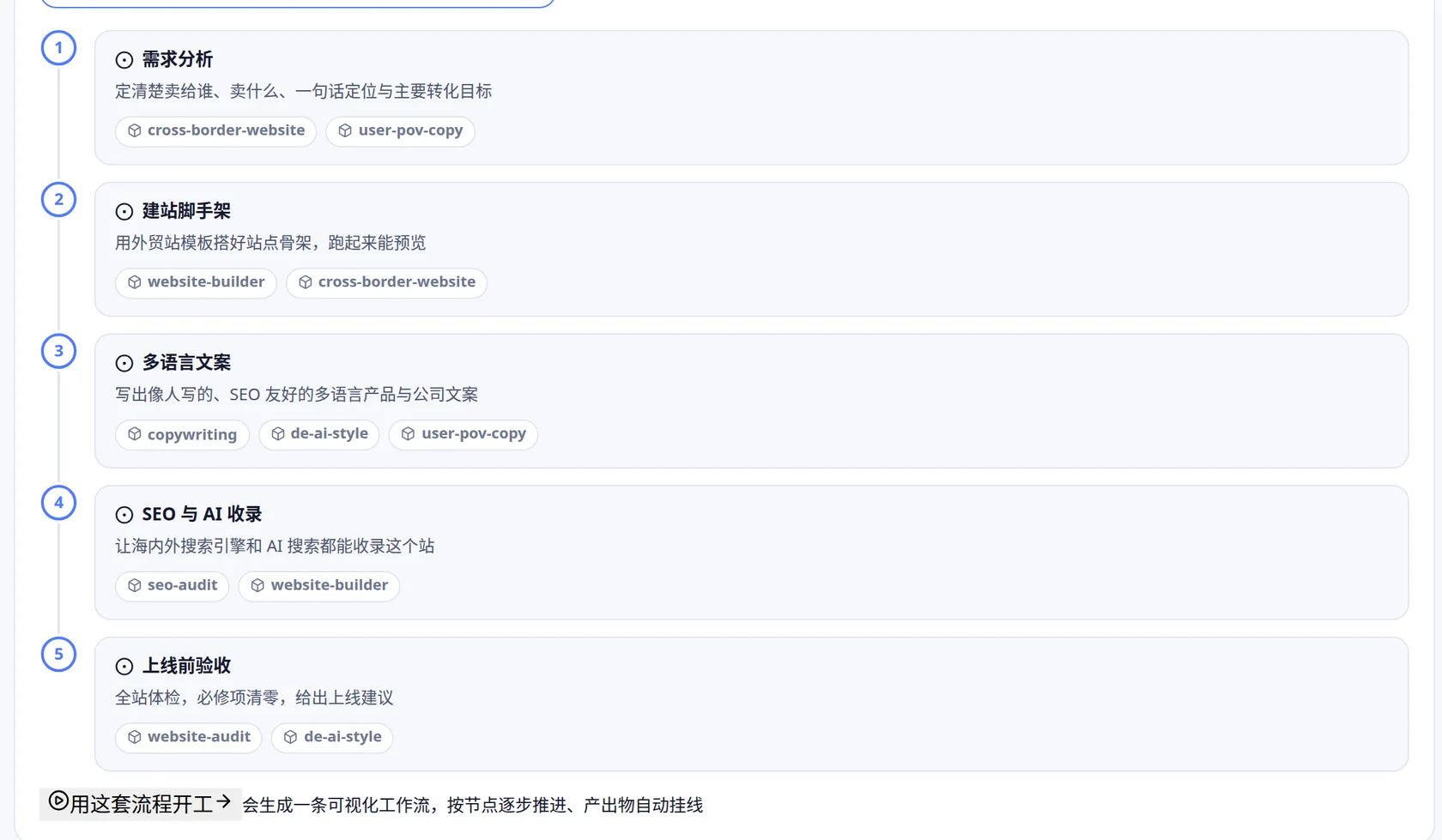
A workflow breaks the job into steps, and each step carries the skills that step needs. Starting one
creates a visual workflow: nodes advance in order and the output is filed back to the project.
Every step states what it does and which skills it uses
Output is attached to the project instead of filed by hand
Switch to the expert view whenever you want to go off-script
From requirements to the pre-launch check: five steps, each with its skills attached.
AI teams
Bring in a team of agents split by role
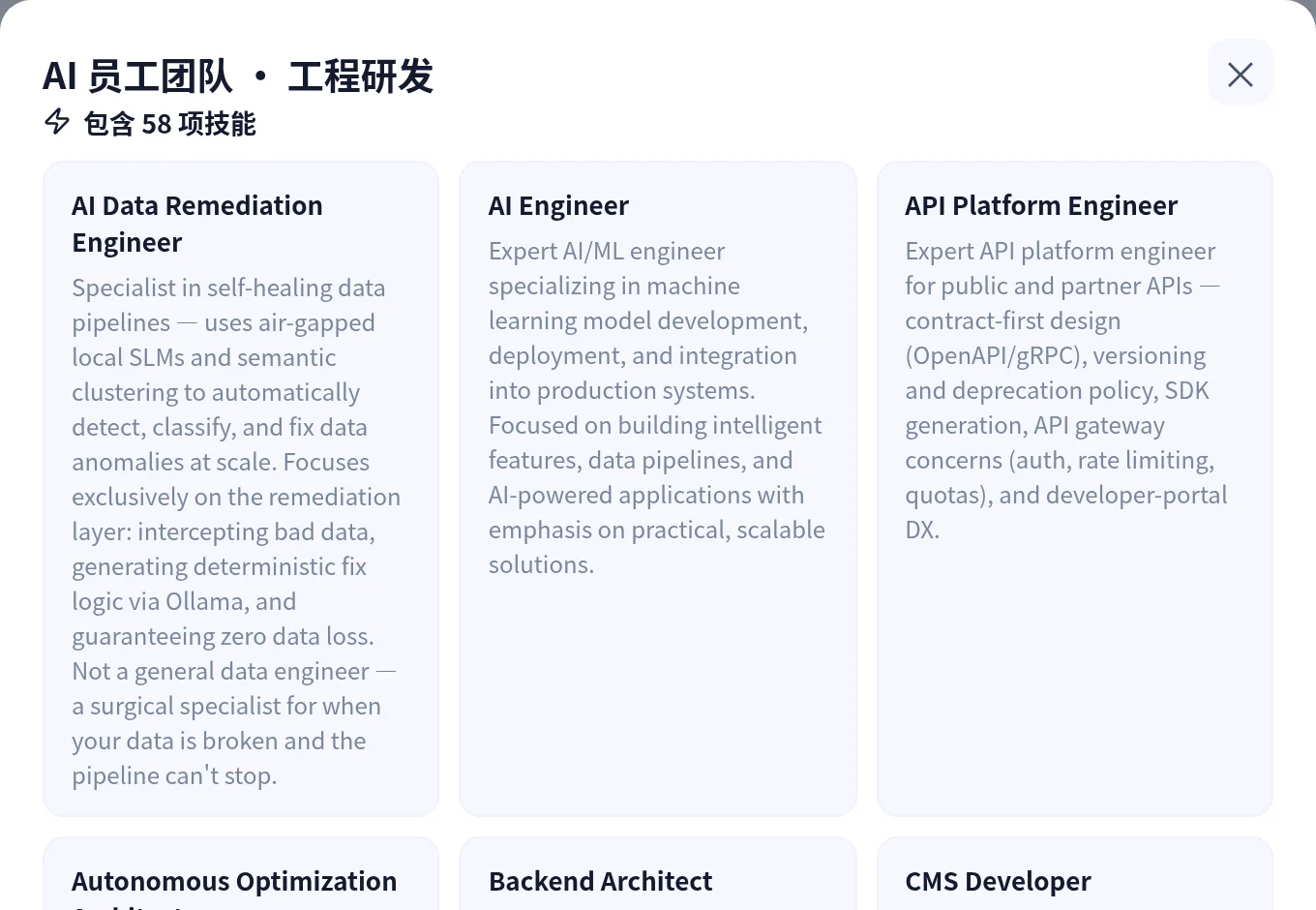
The capability market holds AI teams packaged by function: academic research, design, engineering,
finance, healthcare, marketing. Each team is split by role and carries the skills that kind of work needs.
Split by role, not one assistant expected to do everything
A team carries anywhere from a few to dozens of skills, ready to install
Teams and skills are maintained and distributed by the company
Fifty-eight roles inside one engineering team, each with its own identity, remit and workflow.
Current product scope
What works now, and what needs pilot confirmation
We separate ready-to-use functions from items that need on-site confirmation, so you can estimate the implementation work.
Available now
Day-to-day platform management
Members, departments, roles and login audit
Workspace requests, approval, instances and resources
Model providers, channels and connection tests
Quota plans, user quotas and usage windows
Project, workspace, file and session sharing
AI conversations, run status, tokens and user feedback
Configuration-dependent
Runtime controls
Read-only and project-write sandbox boundaries
User approval before tool and command execution
Viewer, editor and administrator project roles
Time-limited sharing and centralized revocation
Permission prompts differ by agent and are configured for the deployment in use.
Confirmed in pilot
External systems and environments
Specific models, agents and CLI integrations
CRM, ERP, ticketing and internal APIs
Private repositories, file systems and knowledge bases
Private deployment retention and network boundaries
Technical access is not the same as a stable interface or commercial permission. Each item is checked before delivery.
One set of permissions, in detail
You decide what AI may see and do
Before deployment, we confirm data boundaries, record retention and integration scope with your team.
One identityEmployees enter through the platform account, and usage is attached to the actual user, project and resource.
Layered accessModels, tools, files and permitted actions are controlled by role, project and workspace.
Central key custodyModel providers and CLI credentials are configured and distributed centrally instead of living in personal environments.
Execution recordsAI conversations remain attached to the user, workspace, project, runtime and model, with status and usage available for review.
Requests and approvalWorkspaces, resources and capabilities are granted through an approval flow that leaves a record.
Deployment choiceWhere data may not leave the organization, private or hybrid deployment defines the boundary.
How far it reaches
Choose where it runs and how far it reaches
Start with one team, or plan for the whole company. The three core capabilities hold in any of these; what changes is where the data sits and who operates it.
SaaS service
Hosted by us and ready to use, for teams validating the value first.
An enterprise AI workspace. Employees enter the projects they may access from one entry point, project roles decide which models, agents and data they may use, and every run's usage and cost lands on one ledger, so the work survives a handover.
How is this different from personal AI tools such as ChatGPT or Cursor?
Personal AI tools are useful for individual work. We add shared project workspaces, company access rules, quotas and execution records, so colleagues can work together or take over later.
Do we have to replace our existing AI tools and business systems?
Usually not. We first inventory your models, knowledge bases, repositories and business systems, then confirm the integration scope during the pilot.
What can EachRun manage today?
Today you can manage members and roles, workspace requests and instances, model channels, user quotas, resource sharing and AI conversation records. Usage is searchable by user, workspace, project, runtime and model. Tool approval, sandbox boundaries and external integrations depend on the agent and deployment setup.
Does EachRun only retain logs?
Logs are one part of it. Project roles control access, quota windows limit consumption, and supported agents ask for approval before running tools or commands. Administrators can then search records by user, project, model and status.
Is private deployment supported?
Yes. Alongside the SaaS service, enterprise, private and hybrid deployments are available so data boundaries and model access can match your requirements.
Is it hard for employees to start?
Employees do not install an environment or configure keys. On first sign-in the workbench guides them to request a workspace, and they begin once an administrator approves it.
How are the pilot and pricing determined?
A pilot normally uses one engineering or IT team and one or two recurring tasks for four to six weeks. Time, rework, cost and results are recorded before the pilot and compared afterwards. Pricing depends on team size, deployment, model and execution resources, governance requirements and integration scope.
Start with one real AI task.
Tell us which teams use which AI tools, and what is hardest to manage across cost, access, handoffs or execution records.

 Scan to contact our business team